From Muhammad Ali’s Stables to the World’s Show Rings: The Making of the Egyptian Arabian Horse
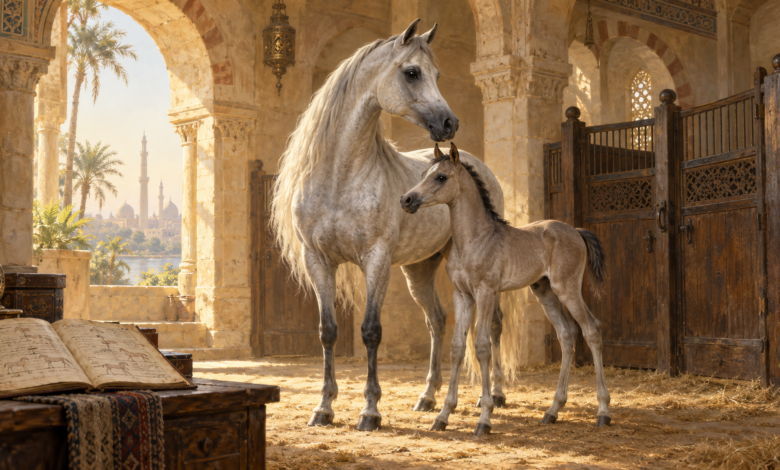
When an Egyptian Arabian enters a show ring, it brings with it a history shaped by more than two centuries of collecting, breeding, documentation, and preservation. Behind its appearance stand generations of rulers, horsemen, private breeders, and institutions whose work helped establish one of the most influential breeding traditions within the Arabian breed.
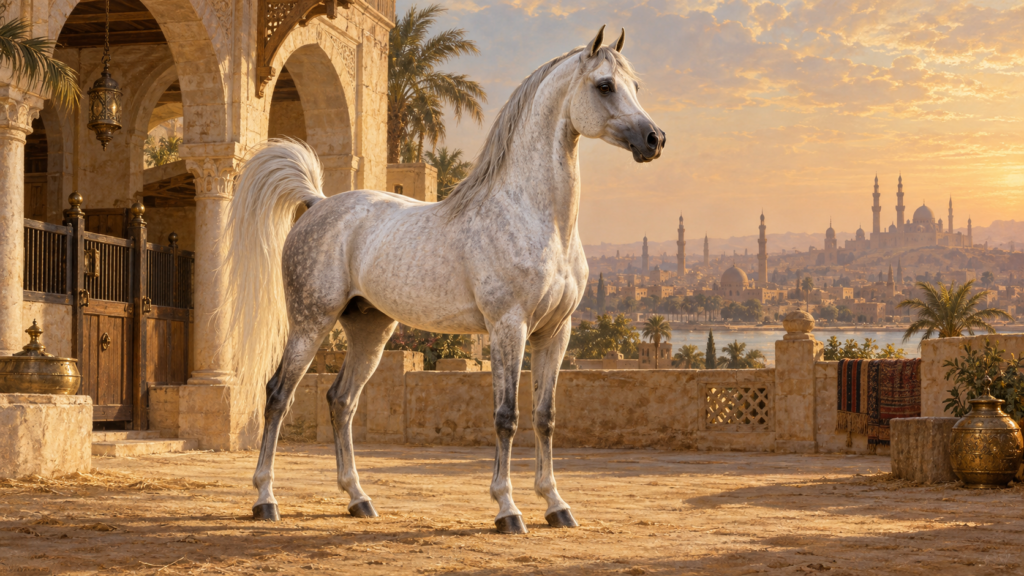
This history did not begin as a project to produce show horses in the modern sense. The horses collected by Muhammad Ali Pasha and his successors were valued for their ancestry, riding qualities, breeding potential, beauty, and prestige. The specialized world of contemporary Arabian halter competition developed much later.
Understanding this distinction is essential: Egyptian Arabian identity concerns ancestry, while show-horse breeding concerns selection for a particular competitive purpose. An Egyptian Arabian may excel in the show ring, but its classification does not depend on winning there. Likewise, a beautiful Arabian with Egyptian ancestry is not necessarily Straight Egyptian.
Muhammad Ali Pasha: Establishing a Nineteenth-Century Foundation
Muhammad Ali Pasha became ruler of Egypt in 1805. During his reign, horses occupied an important place in military life, elite culture, and the activities of the ruling household. Egypt’s connections with Arabia and the Levant facilitated the acquisition of desert-bred Arabian horses.
Muhammad Ali did not create the Arabian horse, which had existed long before his rule. His importance lies in assembling influential collections and providing the resources to maintain and breed them. These collections helped establish the foundation upon which later Egyptian breeding programs developed.
His son Ibrahim Pasha also participated in this equestrian tradition. Within the ruling family, collecting and breeding Arabian horses became an enduring interest. Muhammad Ali’s grandson, Abbas Pasha I, subsequently developed that interest into an especially ambitious effort to acquire horses and investigate their origins.
Abbas Pasha I: Ancestry, Selection, and Documentation
Abbas Pasha I, who ruled from 1848 to 1854, occupies a central place in Egyptian Arabian history. He assembled horses from Bedouin sources and commissioned investigations into their ancestry, ownership, and tribal breeding backgrounds.
For Abbas, a horse’s value extended beyond its appearance. Its recognized origin and the testimony supporting its ancestry were crucial considerations.
This work produced the documents known collectively as the Abbas Pasha Manuscript, whose original material was compiled in the early 1850s. The manuscript records histories and testimonies concerning horses acquired, or considered for acquisition, by his representatives.
It remains an important source for understanding Arabian pedigree traditions in the nineteenth century. However, it should not be treated as a complete modern studbook covering every ancestor of today’s Egyptian Arabians.
Following Abbas Pasha’s death, his collection passed to his son, Ibrahim Ilhami Pasha. After Ilhami died in 1860, a major sale dispersed the remaining horses among different owners. The preservation of this heritage consequently depended on breeders who continued the lines and maintained information about them.
Ali Pasha Sherif: Preserving an Important Inheritance
Ali Pasha Sherif became one of the most significant custodians of horses associated with the Abbas Pasha collection. He bred their descendants and introduced horses from additional desert sources, developing a highly regarded stud during the second half of the nineteenth century.
His contribution was particularly important because the dispersal of earlier collections threatened the continuity of valuable families. By maintaining and breeding these horses, he preserved part of a heritage that might otherwise have disappeared.
His program was not a closed breeding population under today’s Straight Egyptian definition. It reflected the practices of its own era: selecting horses of accepted desert ancestry and combining them within a private breeding program.
The historical record also has limitations. His complete studbook has not survived, and researchers rely on journals, memoranda, sale documents, and later pedigree records. Egyptian Arabian history therefore cannot be reduced to a simple, uninterrupted transfer from Muhammad Ali to Abbas Pasha, then to Ali Pasha Sherif, and finally to El Zahraa. Several collections and sources contributed to the modern population.
Lady Anne Blunt: Preserving Lines Across Borders
During the late nineteenth century, Lady Anne Blunt and her husband, Wilfrid Blunt, acquired horses from Ali Pasha Sherif for their breeding activities at Crabbet in England and Sheykh Obeyd near Cairo.
Lady Anne’s commitment to investigating ancestry and recording individual horses helped preserve information about this period. Her breeding activities also provided a route through which important Egyptian-associated lines survived both within Egypt and internationally.
Among the best-known horses acquired by the Blunts was Mesaoud, who became an influential sire at Crabbet. His descendants helped spread the impact of Egyptian breeding far beyond Egypt.
The movement of horses was not entirely outward. Descendants associated with these breeding traditions later returned to Egypt and contributed to twentieth-century programs. Egyptian Arabian history thus includes exchanges between breeding populations, rather than a single journey from Egypt to the rest of the world.
Princes and Private Breeders: Multiple Sources of Development
Members of the ruling family and other private breeders continued to maintain Arabian horses into the twentieth century. One prominent figure was Prince Mohammed Ali Tewfik, the owner of Manial Palace and a dedicated breeder of purebred Arabians.
He should not be confused with Muhammad Ali Pasha, the founder of the dynasty. They belonged to different generations and contributed during different periods.
Prince Kemal el Din Hussein, the royal Inshass program, and other collections also played roles in maintaining and developing breeding stock. Together with earlier programs and additional imported horses, these sources contributed to the foundation of modern Egyptian Arabian breeding.
The establishment of Egyptian bloodlines was therefore a cumulative process involving many breeders and generations, rather than a single founding decision or mating.
Institutional Preservation and the Role of El Zahraa
As organized breeding developed, preserving Arabian horses became a responsibility extending beyond individual owners. Agricultural institutions provided greater continuity in breeding, identification, and recordkeeping.
The history of the agricultural organization, its Arabian breeding activities, and the establishment of its stud facilities must be distinguished. These were separate developments and should not be assigned one interchangeable founding date.
According to Egypt’s report to the World Arabian Horse Organization in 2025, El Zahraa Stud was established in 1928 as a center dedicated to breeding and preserving the Egyptian Arabian horse.
Institutional continuity helped maintain breeding populations and pedigree information through changes in ownership and government. The Egyptian Agricultural Organization and El Zahraa became important reference points for breeders seeking documented Egyptian ancestry. Their contribution concerned both living horses and the records connecting those horses to earlier generations.
Nazeer and His Descendants: Expanding Egyptian Influence
The twentieth century produced horses whose names became prominent throughout international Arabian pedigrees. Among the most influential was Nazeer, foaled in Egypt in 1934.
His well-known sons included Morafic, Ansata Ibn Halima, Aswan, and Hadban Enzahi. Through these horses and their descendants, Egyptian breeding influenced programs in numerous countries.
Yet attributing this achievement to one stallion alone overlooks the contribution of mares. Each son of Nazeer also represented a particular maternal family. Subsequent generations resulted from combinations with other mares and from the decisions of successive breeders.
Egyptian influence consequently expanded through several routes. Some breeders maintained exclusively Egyptian ancestry, while others combined Egyptian horses with different purebred Arabian lines. Both approaches contributed to the international reach of Egyptian breeding, although they produced different pedigree classifications.
International Expansion and the Straight Egyptian Definition
Egyptian horses reached international breeders through successive waves of importation. Henry Babson’s imports from Egypt in 1932 represent one important milestone and provided the foundation for a distinctive preservation breeding group. Further imports and breeding programs expanded Egyptian influence in later decades.
As this population spread, breeders needed a clear definition identifying horses belonging entirely to the recognized Egyptian group. The Pyramid Society, founded in 1969, developed a definition of the Straight Egyptian Arabian using pedigrees, studbooks, and supporting documents.
Straight Egyptian classification does not depend simply on birthplace, head shape, or an approximate percentage of Egyptian ancestry. A horse born in Europe or the Gulf may qualify as Straight Egyptian, while a horse born in Egypt may belong to a mixed Arabian pedigree.
The term identifies a particular breeding population within the purebred Arabian breed. It does not imply that Arabians from other accepted bloodlines are less purebred.
From Admiration of Beauty to Modern Show Competition
Beauty had long influenced how breeders valued Arabian horses. Modern halter shows subsequently introduced more structured systems for comparison and competition.
Common judging systems assess Arabian type, head and neck, body and topline, legs, and movement. This broader framework recognizes that an Arabian’s appearance encompasses the whole horse, rather than its head alone.
Two objectives can therefore be distinguished in contemporary breeding: preserving Egyptian ancestry and producing horses competitive in the show ring. These goals may coexist within one program, although breeders can give them different priorities.
When a Straight Egyptian is bred to a purebred Arabian from another bloodline group, the offspring may remain a purebred Arabian but does not automatically meet the Straight Egyptian definition. Show success and an appearance associated with Egyptian breeding cannot replace pedigree verification.
The Egyptian Arabian Today: A Living Heritage
Today, the Egyptian Agricultural Organization continues its registration role, while El Zahraa remains an important historical center of Egyptian breeding. Private studs also contribute to the continuation and development of this heritage. Egypt’s 2025 report to WAHO reaffirmed the institutional commitment to preserving Egyptian Arabian horses.
For contemporary breeders, responsibility extends beyond producing the next champion. It includes maintaining families, protecting health and soundness, valuing movement, and preserving accurate records. A breeding program’s worth cannot be measured solely by one fashionable stallion or one striking physical feature.
The journey began with the collection of desert-bred Arabians during Muhammad Ali’s era, gained documentary depth under Abbas Pasha, and continued through Ali Pasha Sherif, Lady Anne Blunt, royal and private breeders, and organized institutions.
Its lasting significance lies in the connection between beauty and documented history. Preserving the Egyptian Arabian means passing on the complete horse: its ancestry, structure, movement, temperament, and the accumulated knowledge that allows each generation to understand the one before it.
by Ahmed Yousef