The winter migration: Why more riders are making Dubai their cold-season base
By Caroline Bucher, Founder, The Canter Club
Every autumn, a quiet migration takes place in the equestrian world. As outdoor arenas across Europe freeze over and the show calendar thins out, a growing number of horses board cargo flights heading south-east, destination Dubai.
It is a pattern that has been building for years, and one I have observed firsthand. I am based in Dubai, where I work with equestrian brands, riders and businesses across the region, including an equine air freight company whose booking patterns tell the story better than any press release could. Every August and September, the flights fill up. UAE-based horses return home from their European summer seasons, and alongside them a growing number of European horses and riders arrive for the winter top sport season.
It is a pattern that has been building for years, and one I have observed firsthand. I am based in Dubai, where I work with equestrian brands, riders and businesses across the region, including an equine air freight company whose booking patterns tell the story better than any press release could. Every August and September, the flights fill up. UAE-based horses return home from their European summer seasons, and alongside them a growing number of European horses and riders arrive for the winter top sport season.
The question is why? And what does this seasonal shift mean for the wider industry?
Two calendars that fit together
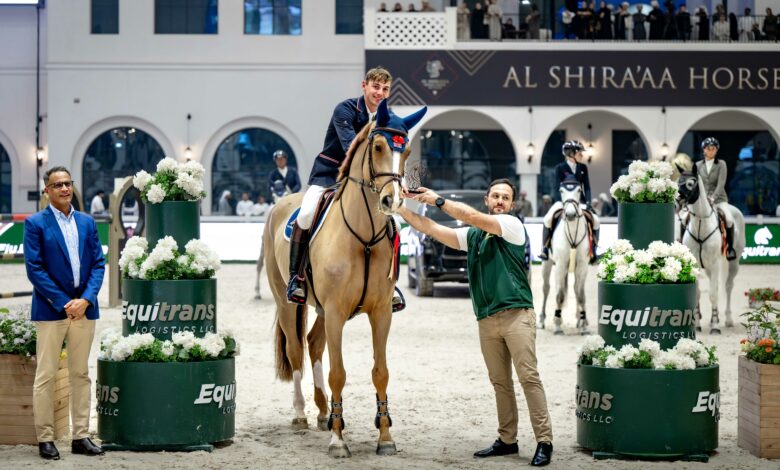
The simplest explanation is timing and distance. The UAE and Europe operate on almost perfectly inverted seasons. When European outdoor competition winds down in October, Dubai’s international season is just beginning. The 2026-27 showjumping calendar starts in early autumn and builds towards flagship fixtures including the UAE President Cup and the Al Shiraa Tour in early 2027, events that now draw top riders and horses from around the globe.
For a competitive rider, the maths is straightforward: instead of five months of indoor schooling and limited starts, a winter in Dubai offers consistent outdoor competition, sunshine and a calendar that keeps horses match-fit through exactly the months when European yards go quiet. Riders who winter in the Gulf can return to Europe in spring with a season’s worth of results already behind them.
The same logic applies in reverse. Many UAE-based competitive riders relocate their horses to Europe each summer, when temperatures at home make outdoor sport impractical. The annual migration runs in both directions, and it is becoming increasingly routine on both ends.
The Wellington question
For decades, the default answer to the European winter was Wellington, Florida. The Winter Equestrian Festival built its reputation as the place where serious riders spent the cold months, and for many yards the annual trip across the Atlantic became tradition. But that assumption is increasingly being challenged, and the UAE is a compelling alternative.
The practical comparison is hard to ignore. From central Europe, Dubai is a six-to-seven-hour direct flight; Florida is nine or more, plus the internal connections. Horses entering the United States face significantly longer quarantine requirements than those flying into the UAE, where the process is considerably shorter and well-drilled after years of high-volume equine traffic. And across the board, from stabling and staff to flights and daily living costs, a Gulf winter tends to come in meaningfully below the cost of a Wellington campaign.
Wellington still offers what it has always offered: depth of sport, an unmatched concentration of top American riders, and a social season of its own. But for European yards weighing up where to spend the winter, the calculation has somehow changed. Dubai is closer, quicker to access, more affordable and the sport on offer now stands on its own merits. Step by step, the Gulf is turning what was once a one-option question into a real choice.
The infrastructure behind the trend
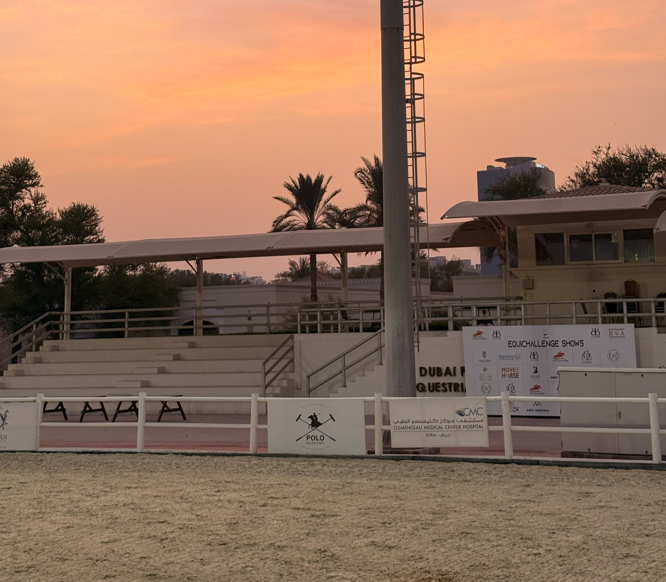
A winter base is only as good as its facilities, and this is where the UAE has invested heavily. Venues such as the Emirates Equestrian Centre, Sharjah Equestrian Centre, Al Habtoor Polo Resort and Meydan Racecourse are built to international standards, many with large climate-controlled indoor arenas.
That investment continues, backed by both government and private-sector commitment to growing the sport. For visiting riders, the practical consequence is that relocating for a season no longer means compromising on training conditions. In many cases, it means upgrading them.
The logistics have also matured. Equine air freight between Europe and the Gulf now runs on well-established routes, with specialist providers handling everything from flight bookings to quarantine paperwork. What once felt like an expedition has become, for many professional yards, a standard fixture in the annual planning calendar.
More than competition
Not everyone who makes the trip comes to compete. Dubai’s equestrian offering has broadened well beyond the arena: polo at the Dubai Polo & Equestrian Club, desert riding at sunrise, race days at Meydan, culminating in the Dubai World Cup, the world’s richest horse race. Surrounding it all is the city’s hospitality infrastructure, which makes it an easy destination not just for riders but for owners, families and the growing segment of travellers who plan trips around their passion for horses.
That combination is part of what sustains the trend. A winter base in Dubai is an easier sell to a rider’s family than one in a quiet village with an indoor school. Event organisers and brands have taken note.
What it means for the industry
The seasonal flow of horses and riders is one visible symptom of a larger shift. In The Canter Club’s Global Equestrian Industry CEO Report 2026, based on interviews with 27 senior industry leaders across eight countries, the Middle East was consistently named among the greatest growth opportunities in the global equestrian market.
For European brands, the winter migration is a practical entry point into that opportunity. The riders who winter in Dubai are, in many cases, exactly the customers those brands already serve at home, now spending five months a year in a market where their favourite products are not always easy to find. Retailers and manufacturers who follow their customers south are finding an engaged, growing audience waiting.
None of this is to say the model is without friction. The summer firmly limits the season’s length, relocation costs remain high, and the market’s seasonality demands careful planning from any business operating here. But the direction of travel, in every sense, is clear.
Looking ahead
As the 2026-27 season approaches, the cargo flights are filling up again. The horses that left for Europe in spring are booked on return flights for August and September, and enquiries from European yards considering their first Gulf winter keep arriving.
The winter migration is no longer a curiosity. It is becoming part of how the international equestrian calendar works and Dubai sits at the centre of it.
About the author
Caroline Bucher is the founder of The Canter Club, a strategic digital marketing agency focused on the global equestrian industry, based in Dubai. She is also a competitive dressage rider. In 2026, The Canter Club published the Global Equestrian Industry CEO Report 2026 – the first consolidated CEO-level insight study dedicated to the equestrian sector, based on interviews with 27 senior leaders across eight countries. The full report is available at www.thecanterclub.com