When a Horse Offers a Second Chance
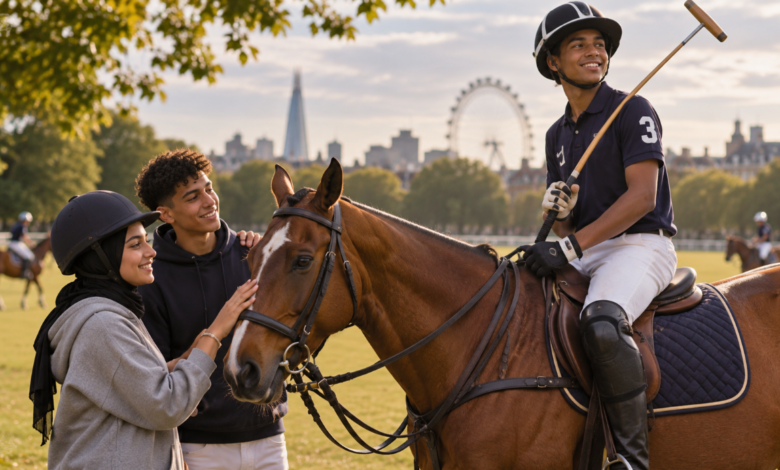
What Did Young People from London’s Disadvantaged Neighbourhoods Learn from Polo?
By Rabie Benaddada,
Moroccan researcher in sports management, specialising in sports marketing, sponsorship, and governance.

A new British study listened to 33 young men and women from vulnerable backgrounds who participated in a polo programme. Their accounts of self-confidence, teamwork, and their relationships with horses invite us to reflect on the role of equestrian sport in shaping individuals.
In our Gulf and Arab culture, horses hold a place unlike that of any other animal. They symbolise horsemanship, heritage, and noble character. But can horses do more than that? Can they help a young person who has grown up in difficult circumstances see themselves in a different light?
This is precisely what a recent study published in the journal Human-Animal Interactions sought to explore through an unusual experience: teaching polo to young people facing challenging social circumstances.
A Sport Associated with the Elite Opens Its Doors to Others
For many people, polo is associated with social status, luxury, and prestigious brands. It is precisely this perception that a registered British charity called Power of Polo has sought to challenge. The organisation aims to make a positive difference in the lives of people facing social, economic, or health-related challenges through the sport.
The programme organises residential courses lasting three to four days, during which participants learn horse riding, horse care, the rules of polo, and teamwork. Each course concludes with a tournament.
The programme also includes social activities, such as watching matches, meeting players, and touring facilities. Participants are provided with equipment and sportswear.
Groups of young people attend through partnerships with charities working in densely populated neighbourhoods in the London Borough of Lambeth, where approximately one-third of residents live in neighbourhoods classified among the most deprived nationally.
This is where the central idea lies: a young person moves from a crowded urban environment into a prestigious rural setting associated with an elite sport. Such a transition may influence their sense of identity, belonging, and relationships with others.
How Was the Study Conducted?
The researchers relied on interviews originally conducted by the charity between 2015 and 2019 as part of its internal programme evaluation. These interviews were subsequently anonymised and reanalysed for scientific purposes, with approval from the research ethics committee at Hartpury University in the United Kingdom.
The sample included 33 young men and women aged between 12 and 25, who participated in 12 programmes held at four polo clubs.
The study classified them as vulnerable individuals because of experiences involving trauma, loss, violence, or gang culture.
Each participant was interviewed up to three times: upon arrival, after the first day, and following the tournament on the final day. A total of 51 interviews were conducted.
Two independent researchers analysed the transcripts using thematic analysis and identified three main themes: psychological benefits, social benefits, and the “Power of Polo” itself, referring to what participants perceived as distinctive about this particular environment.
“I Felt Like I Was Born Again”: What Young People Said About Themselves
Several participants described changes in how they viewed themselves. One even said they felt as though they had been “born again.”
Another explained that they discovered people were not as disappointed in their behaviour as they had previously imagined.
Others spoke about becoming more open-minded and willing to try new experiences. One participant explained that before the programme, they would have rejected anything unfamiliar, whereas afterwards they felt ready to give new activities a chance.
One particularly revealing account came from a participant who nearly fell from their horse during a match.
They explained that, under normal circumstances, they would have given up and walked away. This time, however, they decided to remain on the horse, continued playing, and eventually scored a goal.
It was a small moment, but one that captured how equestrian sport can encourage patience, perseverance, and self-control.
Self-confidence emerged as one of the most prominent benefits reported by participants.
Some said they felt capable of facing anything, while others expressed a desire to explore new sports.
One participant went so far as to say that the most valuable thing they gained from polo was psychological: a stronger sense of self-worth and confidence.
From “Me” to “We”: Learning Teamwork
During the initial interviews, most participants appeared confident in their ability to work within and lead a team. However, their answers were generally brief and centred on themselves.
Many believed that problems within teams were caused by others, particularly those who were loud, overly self-important, or unwilling to listen.
Following the tournament, their language changed.
Their answers became longer, and participants spoke more about the team than about themselves. They emphasised the importance of communication, clearly defined roles, and supporting teammates.
Expressions such as “teamwork makes the dream work” began to appear.
Interestingly, these positive experiences were not limited to winning teams. One participant from a losing team spoke positively about the communication among teammates, even though they had struggled to control the ball.
Interviewers also observed that some young people who had responded with only one or two words on the first day became more willing to speak by the final day.
Participants praised the patience of their coaches and appreciated that they were not placed under unnecessary pressure. They described the coaches as allowing everyone to progress at their own pace.
The Horse: A Relationship That Teaches Trust
The horse itself became one of the strongest themes in the final interviews.
Many participants had never ridden or even approached a horse before joining the programme. Several described initial feelings of fear that gradually disappeared.
One participant explained that their fear diminished when they realised the horse was not responding negatively to them. Another said they already missed their horse, despite only a few days having passed.
Some participants spoke of developing a special “bond” with their horse and described this relationship as their favourite aspect of the programme.
One suggested that building a connection with a horse could make it easier to trust other people afterwards.
Others recognised that maintaining a positive relationship with the horse was essential not only for success in polo but also for safety, given the risks associated with the sport.
These observations are consistent with previous literature on horses, which describes their emotional sensitivity, their ability to provide immediate non-verbal feedback, and their non-judgemental responses to human interaction.
The study also refers to an earlier British review that reported a 27% reduction in reoffending rates among young offenders over a twelve-month period following an equine programme, a finding attributed to their relationship with the horse.
Breaking Stereotypes: “It Is a Sport Open to Everyone”
Most participants initially believed that polo was a sport reserved for wealthy people.
One explained that it was a rich person’s sport and that they had never previously had the opportunity to try it.
Another imagined themselves wearing expensive clothing and enjoying cakes and tea.
By the final day, however, their perceptions had changed.
Those who initially believed polo was “not for people like me” expressed a desire to continue participating.
Another participant explained that their opinion had changed because the people involved in polo had welcomed them.
As a result, they came to see it as an open and accessible sport and felt privileged to have experienced it.
Achievement: Pride Built Through Skill
Participants expressed a strong sense of achievement after learning to control a horse, handle a polo mallet, and take part in a match.
The final tournament was their favourite event of the week because it gave them an opportunity to demonstrate the skills they had acquired in front of others.
One participant said they felt proud simply because they had completed the match without falling from their horse.
Another, who received the title of best player on their team, explained that the recognition had significantly increased their self-confidence.
What Does the Study Not Tell Us?
The researchers themselves emphasise the limitations of their study, which are important for interpreting the findings fairly.
First, the reported benefits are perceived benefits, meaning they are based on participants’ own accounts rather than objective measurements of behavioural change.
Second, the interviews were conducted by the charity’s founder and chief executive. This may have encouraged some participants to provide positive answers or hesitate to mention negative experiences. However, the researchers also acknowledged that the interviewer’s longstanding relationship with participants may have facilitated open and honest conversations.
Third, the interviews were short and structured because of the programme’s busy schedule, and some participants withdrew from the final interviews.
Fourth, the study cannot determine whether the reported benefits resulted specifically from polo or from the overall experience, including the horses, teamwork, and surrounding community.
Nor can it establish whether other equestrian programmes or different sports might produce similar effects.
Consequently, this is an exploratory study that raises more questions than it provides definitive answers.
Questions for the Future
The researchers recommend further investigation into how such programmes influence identity development and the formation of an individual’s sense of self.
They also suggest comparing the contributions of the programme’s different components and following participants over the longer term to understand whether the reported benefits are sustained.
The study notes that the charity also organises programmes for other groups, including military veterans and police officers, and suggests that their experiences deserve further examination.
Another proposed avenue is to bring together groups separated by social distance and unequal power relationships, such as police officers and disadvantaged young people, to encourage greater mutual understanding.
Conclusion: What Horses Can Teach Us
This study offers a window into a remarkable human experience.
Young people who had never imagined polo could be part of their lives found themselves riding horses in an environment that challenged their perceptions of themselves and society.
They spoke of greater confidence, improved communication, stronger teamwork, and an unexpected relationship with an animal that taught them patience and trust.
These are preliminary findings that require further research. Nevertheless, they remind us of something horse enthusiasts have understood for centuries: horsemanship is a school of character and values before it is a sport or a symbol of social status.
When the world of equestrian sport opens its doors to those who never imagined entering it, some may discover, on horseback, something they had not found elsewhere:
A second chance to see themselves differently.