When the Horse Became Poetry: Arabian Horsemanship Between Heroism and Beauty
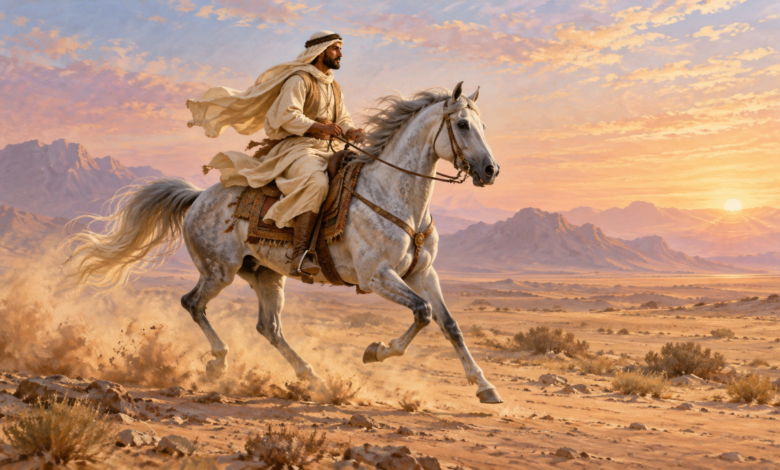
In Arabic poetry, horses have never been merely a means of transport or instruments of warfare. They appear as companions, witnesses to courage, and embodiments of beauty, movement, and pride. When poets describe them, they also explore a broader world of human values and emotions: loyalty, fear, love, ambition, and the desire to overcome limitations.
This connection gave poetry and horsemanship a shared language. The rider establishes a reputation through action, while the poet gives that action a form that survives in memory. In figures such as Antarah ibn Shaddad, these roles come together: the poetry speaks from within the experience of battle rather than observing it from a distance.
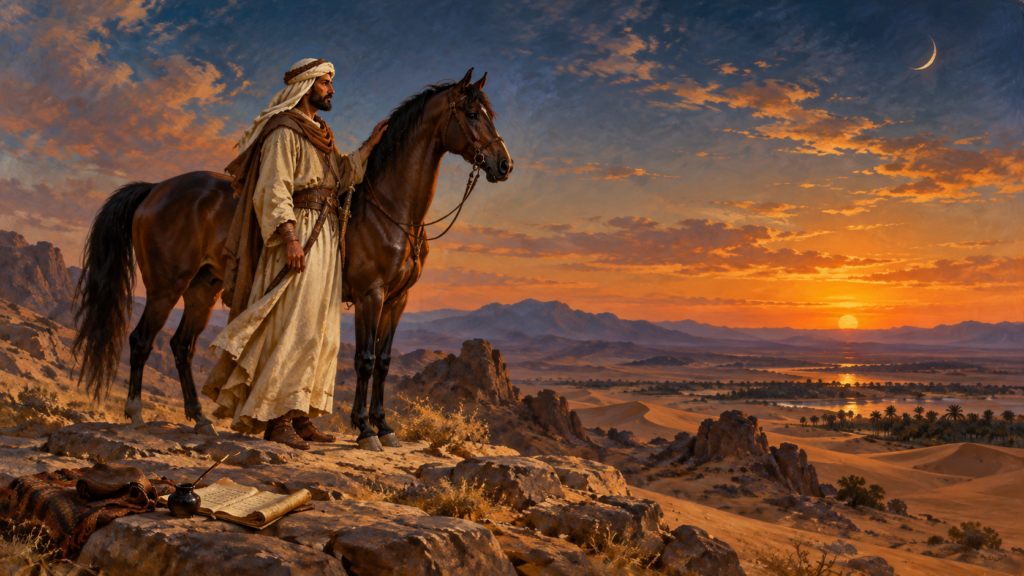
Yet this literary tradition is diverse. Not every poem about horses concerns warfare, and not every image of a horseman celebrates violence. Horses accompany hunting, journeys, expressions of pride, and moments of longing. They also appear as vulnerable creatures that suffer alongside their riders.
The Horse as More Than a Poetic Subject
Horses occupy a prominent place in Arabic poems of description, pride, and martial courage. Their presence reflects their importance in human experience: they allow riders to travel farther and faster, and they accompany them in situations where success or survival depends on the partnership.
Descriptions of horses consequently become descriptions of their riders. When a poet praises a mount’s speed, steadiness, and responsiveness, he also presents himself as someone capable of recognizing and directing those qualities.
At the same time, detailed description draws attention to the animal itself. Movement, physical structure, gait, and response become material for language. The poem brings observation into contact with imagination, transforming the horse’s visible qualities into an emotional experience.
Imru’ al-Qays: Beauty Revealed Through Movement
One of the most celebrated descriptions of a horse appears in the Mu‘allaqah of Imru’ al-Qays. In a close prose rendering, he describes his mount as:
Wheeling, withdrawing, advancing, retreating together—
like a mass of rock swept down from above by a torrent.
The description belongs to a hunting scene and should therefore not be confined to a military interpretation. The horse’s ability to change direction and respond swiftly makes movement itself the object of admiration.
The succession of opposing actions compresses rapid changes into a single poetic moment. The reader almost loses the ability to separate one movement from the next.
The comparison with a rock carried downward by a torrent adds force and momentum. Drawing on the natural world, the poet makes the horse’s movement feel powerful and immediate.
Here, beauty is not a static arrangement of features. It emerges when the horse moves and responds to its surroundings. For a modern reader, this offers a wider understanding of equine beauty: appearance and performance can belong to the same experience.
Antarah: The Horse as Witness
Where Imru’ al-Qays creates a vivid scene of movement, Antarah ibn Shaddad gives horses the role of witnesses. Addressing his beloved, he says, in translation:
Why not ask the horses, daughter of Malik,
if you do not know what you have yet to learn?
Within the Mu‘allaqah, this appeal introduces an account of his courage and conduct in battle. The horses are summoned to testify to what they have experienced with him.
The image moves them beyond the status of equipment. They become companions that know their rider through shared danger. Antarah’s claim to distinction rests on actions, and he calls upon those present during those actions to confirm it.
Love and horsemanship also meet here. The poet is not simply announcing his achievements to an anonymous audience. He addresses someone whose recognition matters to him.
Behind the warrior’s strength lies a human desire to be understood and valued. This gives the martial passage an intimate dimension: the battlefield and the beloved occupy the same poetic space.
The Suffering Horse: Another Face of Heroism
Antarah’s poem does not describe strength alone. In another passage, his horse recoils from the impact of spears and communicates its distress through tears and sound.
This scene invites a different reading of the relationship between rider and mount. The horse is no longer simply carrying its rider toward victory. It possesses a vulnerable body, and the poet notices its suffering.
The passage complicates the celebration of courage by revealing its cost. The animal shares the danger without being able to explain its experience in human language; poetry gives that experience a place within the narrative.
It would be misleading to treat this scene as evidence of a modern system of equine welfare. Nevertheless, it remains a powerful literary acknowledgment of the horse’s pain and of the rider’s attention to it.
Al-Mutanabbi: Horsemanship and the Written Word
In the poetry of al-Mutanabbi, horsemanship becomes part of an expansive portrayal of the self. One of his most famous lines may be translated as:
Horses, night, and the desert know me—
and sword, spear, paper, and pen.
The line appears in the poem commonly identified by its opening, Wāḥarra qalbāh, and brings together the worlds of travel, weapons, and writing.
It can be read as a declaration of a many-sided identity. Horses, darkness, and the desert suggest experience and confrontation, while paper and pen evoke knowledge and expression. The poet’s pride encompasses both action and the ability to give action lasting form.
The claim that these things “know” him is especially striking. His surroundings become witnesses to his reputation, recalling Antarah’s appeal to the horses but extending it across a wider field of experience.
This poetic identity should also be distinguished from historical biography. The line reveals how al-Mutanabbi presents himself; it cannot, by itself, establish every achievement or experience it implies.
Horsemanship as an Ethical Question
Poetry about horsemanship raises a question beyond riding skill: what gives a horseman worth?
Courage may stand at the center of the answer, but the poems also invite reflection on loyalty, responsibility, and the restraint of power. The ability to inflict harm does not alone establish moral distinction.
The past should not be presented as an ideal world governed consistently by noble conduct. Arabic poetry contains anger, vengeance, exaggeration, and fierce pride alongside tenderness and generosity.
These tensions contribute to its richness. They reveal people in their ambitions and contradictions, rather than offering a flawless model of heroism.
A thoughtful reading therefore asks about the purpose of courage, the consequences of conflict, and the people and animals who share its burden.
Making Movement Audible
The force of equine description comes from both imagery and the arrangement of language. In Imru’ al-Qays, the sequence of compact, opposing terms creates an impression of speed and rapid changes of direction. In Antarah’s account, the horse’s sounds redirect attention from the surrounding battle toward the individual animal.
Poetic meter need not imitate hoofbeats literally to make movement perceptible. Rhythm, repetition, and the order of words can bring the reader closer to the sensation of a scene.
Poetry can consequently achieve something a still image cannot fully convey: it presents the body in motion, time accelerating, and emotions changing within an unfolding event.
Reading This Heritage Today
For today’s equestrian reader, these poems offer more than memorable lines to accompany photographs. They encourage closer observation of movement and deeper consideration of the relationship between horse and rider.
They also help restore the animal’s presence within stories usually centered on human ambition. The horse is a participant whose strength, responsiveness, and vulnerability shape what becomes possible.
Poetry, however, does not replace scientific knowledge. Metaphor and exaggeration serve artistic expression; they should not be used as evidence of sound conformation, specific behavior, or pedigree.
Literature and modern equine knowledge can instead enrich one another. Poetry helps us understand what horses have meant to people, while equine science helps us understand what horses need.
Imru’ al-Qays captures the beauty of movement. Antarah presents the horse as witness and suffering companion. Al-Mutanabbi places it within an identity that unites horsemanship and writing. Through these different visions, the horse continues to carry questions of beauty, courage, and responsibility across generations.
Ahmed Yousef