Clever Hans: The Horse That Fooled the World’s Scientists
A horse that could count, solve mathematical problems and answer questions? More than a century ago, one extraordinary animal convinced audiences and respected scientists that horses might possess intelligence far beyond anything previously imagined.
His name was Clever Hans, and his remarkable story would change the way scientists study animal behaviour forever.
The Horse That Could Do Mathematics
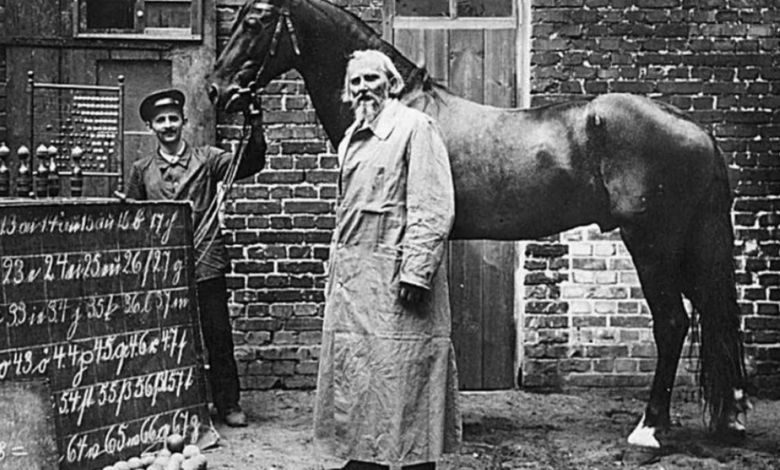
In Germany, a retired mathematics teacher named Wilhelm von Osten believed that animals were capable of extraordinary intelligence.
Determined to prove his theory, he began training his horse, Hans, to respond to questions by tapping his hoof.
The results astonished spectators.
Ask Hans a mathematical question, and he would tap the ground the correct number of times. He appeared capable of addition, subtraction, multiplication and even answering questions about calendars and time.
His abilities seemed almost impossible.
Before long, the horse became a sensation, attracting crowds, journalists and scientists eager to witness his remarkable performances.
Scientists Could Not Explain His Talent
As Hans became increasingly famous, experts began questioning whether his abilities were genuine.
Was the horse actually solving mathematical problems, or was his owner secretly signalling the answers?
A scientific commission investigated the case in 1904.
Surprisingly, investigators found no evidence of deliberate trickery.
Hans could sometimes answer questions correctly even when his owner was absent.
The mystery deepened.
How could an ordinary horse perform tasks that appeared to require human reasoning?
The Experiment That Revealed the Truth
Psychologist Oskar Pfungst eventually conducted a series of carefully controlled experiments.
He noticed something extraordinary.
Hans performed well when the person asking a question already knew the correct answer.
However, when the questioner did not know the answer, the horse’s accuracy declined dramatically.
The same happened when Hans could not see the person asking the question.
Pfungst discovered that the horse was responding to extremely subtle changes in human body language.
As Hans tapped his hoof, people unconsciously changed their posture and facial expressions when he approached the correct answer.
Hans noticed these tiny signals and stopped tapping at precisely the right moment.
The horse was not performing mathematics.
He was reading people.
An Intelligence Nobody Expected
Although the discovery disappointed those who believed Hans possessed mathematical abilities, it revealed another remarkable talent.
The horse was extraordinarily sensitive to human behaviour.
He could detect physical signals so small that the people producing them were often completely unaware of their own movements.
Hans demonstrated the remarkable observational abilities that horses can develop through close interaction with humans.
For generations, horse owners and riders have recognised the importance of communication, trust and understanding between humans and horses.
Clever Hans provided an unforgettable scientific example of just how subtle that communication can become.
The Horse That Changed Science
The story of Clever Hans became a landmark in experimental psychology.
Scientists realised that researchers could unintentionally influence an animal’s behaviour simply through their expectations or body language.
This phenomenon became known as the Clever Hans Effect.
Today, researchers use carefully controlled experimental methods to prevent unconscious signals from influencing their results.
A horse that appeared to solve mathematics had helped expose a fundamental problem in scientific testing.
A Legacy Beyond Mathematics
Clever Hans never proved that horses could calculate like humans.
Instead, he revealed something equally fascinating: the extraordinary ability of animals to observe and interpret human behaviour.
His story remains one of the most unusual chapters in equestrian history.
It reminds us that intelligence does not always appear in the form we expect.
Sometimes, the greatest discovery is not what an animal knows, but what it notices.