The Mistake of Training with Resistance Bands in Modern Polo
Resistance bands have become a common sight in modern polo: before matches, on the side lines, and during travel. Their practicality and ease of use have made them an almost automatic tool in player preparation.
However, their use raises an uncomfortable question: are we really training for what the game demands?
Resistance bands are useful and have their place in training plans, but their popularity doesn’t make them the best option for every goal. In particular, when the focus is on developing strength, speed, and power, their logic can conflict with the real demands of polo.
The Paradox of Resistance Bands
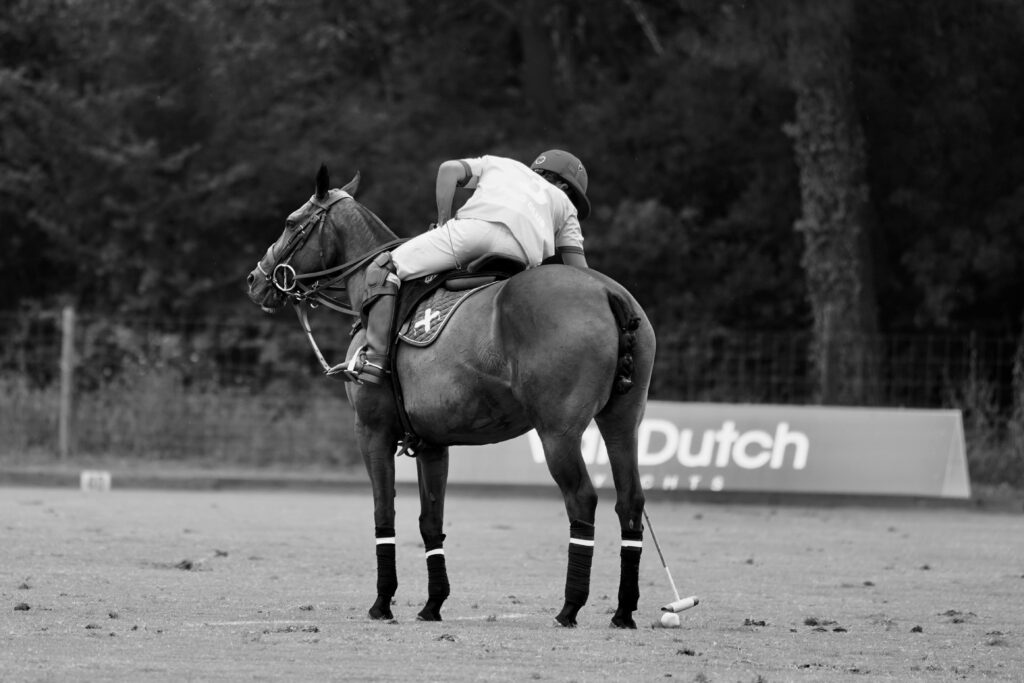
In polo, ballistic movements like the drive or the back require generating a large amount of force at the beginning of the movement, with the aim of overcoming inertia and transferring energy to the mallet before impact. It is in this initial moment that much of the quality of the movement is defined.
Elastic bands, on the other hand, present an ascending resistance profile: as they stretch, the tension increases, and with it, the demand. This means that the greatest effort occurs at the end of the movement, when in polo the main action should have already taken place.
As Zatsiorsky and Kraemer (2006) point out, this type of resistance trains the neuromuscular system to produce more force in the final phases of the movement. In the context of polo, this represents a contradiction: the body is being trained in a direction opposite to that of the sport’s movement.
Training in the Right Direction
If the goal is to improve performance on the field, training must respect the logic of the game.
This implies prioritizing stimuli that allow force to be applied from the beginning of the movement, without interfering with acceleration and with more constant resistance throughout the swing. In this sense, the use of pulleys and free weights allows training that is more aligned with the demands of the movement, respecting the long lever arm and the fluidity and stability that the shoulder requires during the swing. Similarly, medicine ball throws—especially those performed with one arm—represent one of the most direct transfers to tackling. This type of stimulus trains the neuromuscular system to generate high levels of force in the initial phases of the movement, replicating the actual dynamics of the game.
More than focusing on specific exercises, the key is understanding what kind of stimulus the body needs to perform better on the field.
Resistance Bands: Activation, Not Development
This doesn’t mean that resistance bands should be eliminated. The problem isn’t with the tool itself, but with how it’s used.
Resistance bands are especially useful for warm-ups and pre-game activation. Their versatility allows for the involvement of stabilizing muscle groups—such as the rotator cuff—preparing the body for exertion without generating excessive fatigue.
However, when the goal is to develop explosive power, their contribution is limited. In that context, insisting on their use as the primary training tool can be not only inefficient but counterproductive.
Final Verdict
This isn’t about popularity, but about aligning with the sport’s actual demands.
If modern polo requires generating power and speed from the very beginning of the movement, training must respect that logic. Otherwise, we’ll not only be training inefficiently, but also in the wrong direction. Setting aside the comfort of practicality to train with purpose is part of the path toward an increasingly demanding polo, where the player not only rides the ball, but also performs like a high-performance athlete.